
$14.00
Add to Cart
BG Store | Purple Smoketree, Cotinus coggygria atropurpurea, 20 Seeds (Fast Showy, Fall Color) Read
10 available
Details
Shipping: US-Mainland: free (more destinations)
Condition: Brand new
Returns: does not accept (more)
Leaf: Alternate, simple, oval, entire margin, blunt-tipped, 3 to 5 inches long; dark purple above, paler below.
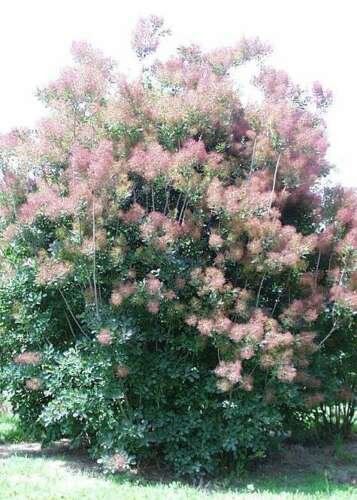
Flower: Small, greenish-yellow occurring on many finely branched, slender clusters which resemble puffs of smoke; changes color from yellowish to pink as the age; few actual flowers occur. The flowers attract bees.
Fruit: Light brown, 1/8 inch long, kidney-bean shaped; few appear on the slender branched, hairy stems.
Twig: Moderately stout, reddish green or with a purple tint, glaucous, turning gray-brown with age; buds small, leaf scar not lobed.
Bark: Initially light gray-brown, later splitting into thin strips and becoming scaly and darker.
Form: A shrub to 15 feet tall with an equal spread.
Other Names: Purple Smoke Tree, European Smoketree, Smoke Bush
Zone: 5 to 8 (possibly 4)
Growth Rate: Fast
Plant Type: Deciduous, multi-stemmed shrub
Family: Anacardiaceae
Native Range: Southern Europe to central China
Height: 10 to 15 feet
Spread: 10 to 15 feet
Shape: Upright, Rounded
Bloom Time: May-July
Bloom Color: Yellow
Sun: Full Sun
Fall Color: Bright shades of yellow, orange, purple and red.
Drought Tolerance: High
Water: Medium
Maintenance: Medium
Site Requirements /Soil Tolerances: Easily grown in average, medium, well-drained soils in full sun. Tolerates wide range of soils except wet, poorly-drained ones. Prefers somewhat infertile loams, but also does well in poor, rocky soils. Good drainage is essential. Shallow fibrous root system.
Culture: If bloom is not a concern, stems may be cut back hard in early spring each year to a framework to induce growth of vigorous new shoots with slightly larger than normal leaves. Such hard annual pruning will control size, but most likely at the expense of profuse flowering.
Easy to transplant.
Uses: Single specimen, group or mass in shrub borders or sunny areas around the home. Long-lasting summer smoke display makes this a striking accent plant. Also may be used as an informal hedge or screen (a smoke screen as it were). Can be trained as a small tree.
Sowing Cotinus coggygria atropurpurea Seeds:
For best results, please follow the instructions in the order provided.
Scarify: Pour Hot water over seed. Soak water for 12 hours
Stratify: Warm for 60 Days, then Cold for 90-120 days, 40 Degrees F in a Moist Medium (Not wet).
Germination: Sow 1/8” Deep, Keep warm and moist (Not wet).
Germination:
Seeds Packets are labeled with seed name and sowing details.
Seeds have not been pretreated unless specified in the listing.
Seed is not a specific Cultivar (Variety) unless specified in the listing.
Due to the many factors involved in successful germination, Seller cannot be responsible for buyers growing methods or mistakes.
I have provided what I believe to be a good overview on this page (which you are free to print for further reference), however, it is still recommended to check specialist literature for more details and practices specific to your climate and soil conditions to avoid mistakes in the germination and growing process.
Flower: Small, greenish-yellow occurring on many finely branched, slender clusters which resemble puffs of smoke; changes color from yellowish to pink as the age; few actual flowers occur. The flowers attract bees.
Fruit: Light brown, 1/8 inch long, kidney-bean shaped; few appear on the slender branched, hairy stems.
Twig: Moderately stout, reddish green or with a purple tint, glaucous, turning gray-brown with age; buds small, leaf scar not lobed.
Bark: Initially light gray-brown, later splitting into thin strips and becoming scaly and darker.
Form: A shrub to 15 feet tall with an equal spread.
Other Names: Purple Smoke Tree, European Smoketree, Smoke Bush
Zone: 5 to 8 (possibly 4)
Growth Rate: Fast
Plant Type: Deciduous, multi-stemmed shrub
Family: Anacardiaceae
Native Range: Southern Europe to central China
Height: 10 to 15 feet
Spread: 10 to 15 feet
Shape: Upright, Rounded
Bloom Time: May-July
Bloom Color: Yellow
Sun: Full Sun
Fall Color: Bright shades of yellow, orange, purple and red.
Drought Tolerance: High
Water: Medium
Maintenance: Medium
Site Requirements /Soil Tolerances: Easily grown in average, medium, well-drained soils in full sun. Tolerates wide range of soils except wet, poorly-drained ones. Prefers somewhat infertile loams, but also does well in poor, rocky soils. Good drainage is essential. Shallow fibrous root system.
Culture: If bloom is not a concern, stems may be cut back hard in early spring each year to a framework to induce growth of vigorous new shoots with slightly larger than normal leaves. Such hard annual pruning will control size, but most likely at the expense of profuse flowering.
Easy to transplant.
Uses: Single specimen, group or mass in shrub borders or sunny areas around the home. Long-lasting summer smoke display makes this a striking accent plant. Also may be used as an informal hedge or screen (a smoke screen as it were). Can be trained as a small tree.
Sowing Cotinus coggygria atropurpurea Seeds:
For best results, please follow the instructions in the order provided.
Scarify: Pour Hot water over seed. Soak water for 12 hours
Stratify: Warm for 60 Days, then Cold for 90-120 days, 40 Degrees F in a Moist Medium (Not wet).
Germination: Sow 1/8” Deep, Keep warm and moist (Not wet).
Germination:
Seeds Packets are labeled with seed name and sowing details.
Seeds have not been pretreated unless specified in the listing.
Seed is not a specific Cultivar (Variety) unless specified in the listing.
Due to the many factors involved in successful germination, Seller cannot be responsible for buyers growing methods or mistakes.
I have provided what I believe to be a good overview on this page (which you are free to print for further reference), however, it is still recommended to check specialist literature for more details and practices specific to your climate and soil conditions to avoid mistakes in the germination and growing process.


